Product Overview
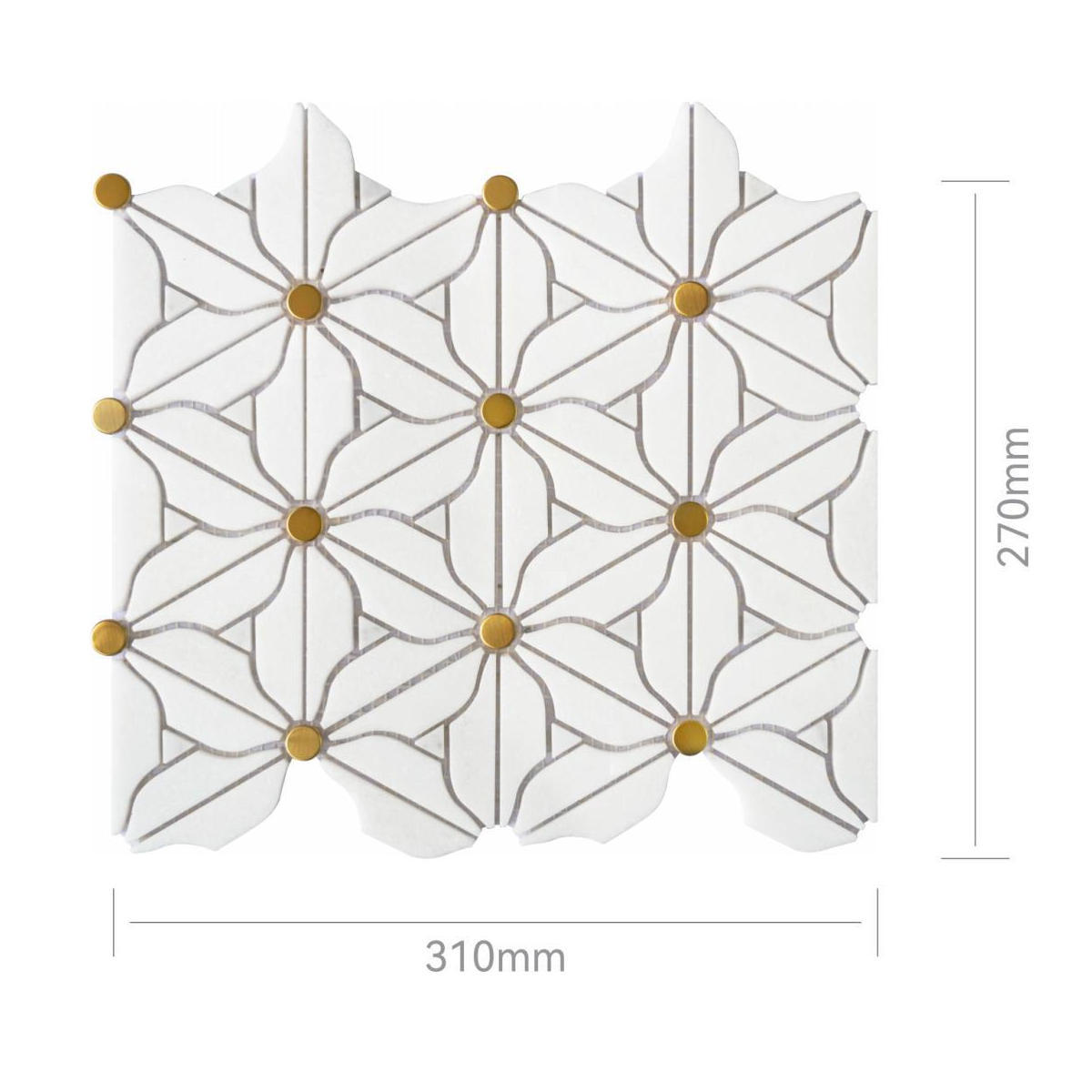
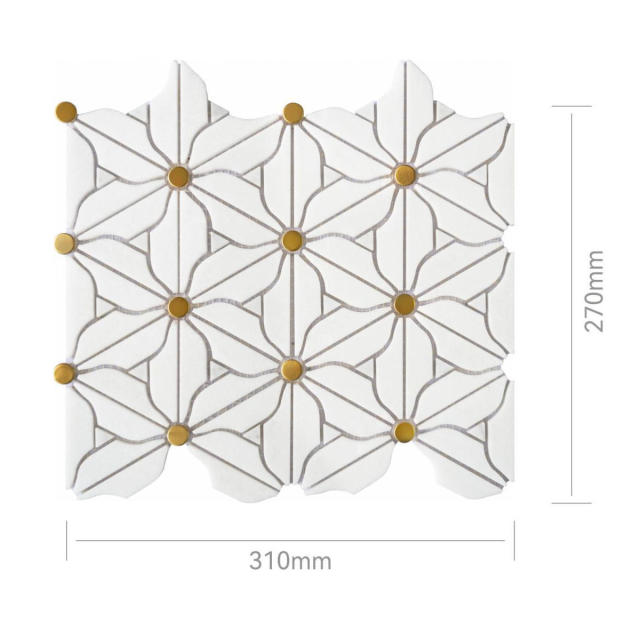
Bestone MM649 is a natural white marble mosaic cut into an interlocking floral geometry, with a small gold-tone metal accent set into each motif. The face is polished, so the white reads bright rather than chalky and the accents pick up a hard edge of light under downlights. Each sheet is thin enough to face a wall without pushing the finished line far off the surrounding plaster.
The pattern is the reason buyers choose this white marble stone mosaic tile over a plain field mosaic. Small marble pieces are laid face-up into a repeat that reads as a continuous surface from three or four metres away and as crisp geometric detail at arm's length. Sheets key into one another through wavy edges instead of a straight grid, so the repeat carries on across a long elevation without a hard line at every sheet edge. Because the pieces are mesh-backed, they hold their spacing while the adhesive sets, and an installer can cut a sheet with an ordinary diamond blade.
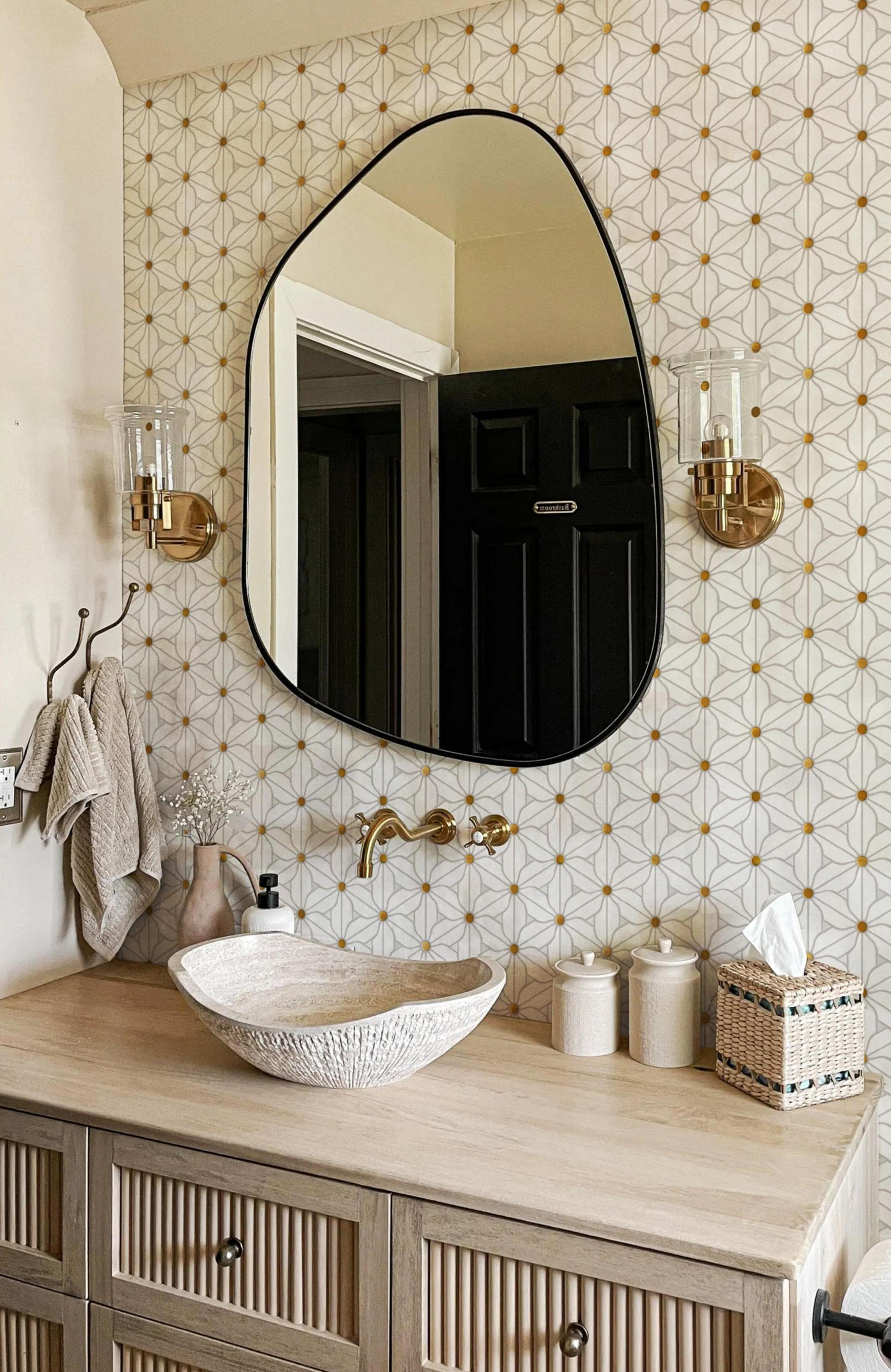
It sits naturally beside a white quartz or marble vanity top, and with brushed, chrome or brass-tone tapware. Designers usually place it as the one decorative surface in an otherwise quiet room, which is why the pattern is regular rather than random: it can cover a whole wall without becoming noisy.
Manufacturing & Quality Control
- Select and grade the stone. White marble blocks are sorted for ground tone before anything is cut, so the whitest and the greyer material do not end up in the same carton.
- Cut the geometry. Each shape in the repeat is cut from the graded stone; offcuts that are too veined or too grey are set aside rather than mixed back in.
- Lay the repeat. Pieces are assembled face-up into the interlocking floral pattern and the gold-tone accents are set into their positions. The setters who do this work have laid the pattern many times over and keep the joints even.
- Mount the mesh. A mesh backing is bonded to the assembled face, so the sheet travels and installs as one unit and the pieces stay in register.
- Grind and polish. The face is ground to a consistent thickness and water-polished to the sheen the finished sheet arrives with.
- Inspect and pack. Our QC team checks pattern alignment, chipped corners, tone drift across the batch and mesh adhesion before the sheets are packed, and palletised cartons are loaded for the container.
Installing Mesh-Backed Sheets
- Check the substrate first. A mosaic gives back exactly what the wall is, so confirm the render or board is flat, dry and sound before the first sheet comes out of the carton.
- Dry-lay before fixing anything. Find the centre of the elevation, lay three or four sheets on the floor in sequence and decide where the repeat breaks at corners and how the pattern meets the ceiling line.
- Use a white thin-bed adhesive. Grey adhesive can shadow through pale marble and leave the wall looking dull; mix to the adhesive manufacturer's ratio and keep the bed even.
- Fix sheet by sheet and keep joints consistent. Press each sheet evenly with a float or roller and work in areas small enough that the adhesive has not skinned over before the sheet lands.
- Cut at edges and services with a diamond blade, taping the face where a cut runs close to the accents so the metal does not lift.
- Seal the marble before grouting, then grout in a tone close to the stone so the pattern still reads as a surface rather than a grid. Remove grout haze from the polished face before it cures.
- Protect the finished wall while other trades are still working — joinery dust and plaster splashes are harder to remove from a polished face than from a matt one.
Commercial Wall Applications
Hotel guest bathrooms are the natural setting for this polished white marble mosaic for commercial wall decoration: the sheet goes on the wall behind and around the vanity, where the mirror and the downlights make both the polish and the gold accents work. Because the sheet is a repeated pattern rather than a random blend, the same wall detail can be repeated in every room of a floor without looking different from door to door. Hospitality corridors, lift lobbies and stair landings suit it for the opposite reason — long elevations where the repeat runs uninterrupted and the wall does the decorating. Restaurant and café washrooms use it where a small wall has to carry the whole interior idea. Store fit-outs specify it on boutique back walls, display niches and cash-desk surrounds, where a client sees the finish at close range. In workplace and medical interiors it turns up on reception walls, showroom backdrops and waiting areas that need a surface harder to date than a paint colour. Multi-unit residential projects use it on apartment bathroom walls, where one approved sheet is specified across every unit and the order is sized from the unit count.
Care & Maintenance
- Clean with a pH-neutral stone soap and clean water, then rinse and dry with a soft cloth. This is the routine that keeps a polished face reflective in daily hotel or commercial use.
- Keep acid off the wall. On a white marble stone mosaic tile, vinegar, citrus cleaners and many bathroom sprays dull the polish and cloud the gold-tone accents over time.
- Wipe spills rather than letting them sit, particularly anything coloured — marble is a natural stone and a polished face is not a sealed barrier forever.
- Re-seal on a schedule that matches the traffic. A busy commercial wall needs it more often than a private bathroom, and your installer or maintenance contractor can set the interval for the products they use.
- Skip abrasive pads and scouring powders; they leave a haze that no polish will bring back on site.
- Cover the finished wall during later trades and remove the cover once the dust has settled, rather than wiping plaster dust across the surface.
Sheet Specifications
| Stone | Natural white marble |
| Accent inlay | Stainless steel gold brass |
| Pattern | Interlocking floral with gold-tone accents |
| Sheet size | 308 × 355 mm |
| Sheet thickness | 7 mm |
| Weight per sheet | 1.85 kg |
| Surface finish | Polished |
| Mounting | Mesh-backed |
| Sheets per carton | 11 |
| Cartons per pallet | 72 |
| Pallets per 20 ft container | 20 |
| Carton size | 315 × 370 × 95 mm |
| Carton weight | 21 kg |
| Pallet weight | 1,537 kg |
Sheet Advantages
- One pattern carries a whole elevation. The repeat covers a long wall without a plain-tile break, so a lobby, corridor or bathroom wall reads as a single surface instead of a decorated patch.
- The accents are already in the sheet. Gold-tone pieces sit inside the layout, so nobody on site has to align a separate metal trim line.
- Polished white that stays bright. The polished face reflects window light and downlights, which lifts corridors and small bathrooms that get little daylight.
- Mesh backing speeds the install. Sheets go up whole, joint spacing stays even, and less cutting happens at height.
- Graded stone rather than mixed stock. Marble is sorted for tone before cutting, so cartons from one order sit close together once they are on the wall.
- Pattern development in-house. Our R&D department can work through a variation on the repeat or the accent with you before a project commits to it.
- OEM and own-brand orders. We provide OEM service, so the sheet can ship under your own label and packing for your showroom or your own customer.
- Manufacturing depth behind the sheet. Our base runs four automatic quartz slab production lines and modern processing machinery alongside the mosaic workshop, which is how a project can draw its wall mosaic and its vanity tops from one order.
Test Data & Documentation
Start with the client's document list, not the finish.
Most commercial wall packages — hotel corridors, lobby feature walls, bathroom elevations in a fit-out — ask for paperwork at handover, and that paperwork attaches to the colour and the production run rather than to the pattern. Send us the checklist from the tender or from the client's specification before the shade and sheet format are signed off: the test report they name, the origin wording their broker needs, the declaration their consultant has requested, the batch record their clerk of works wants to file. We will go through it line by line against this white marble stone mosaic tile and tell you plainly what exists for the colour and what does not, so nothing surfaces in the last week before completion.
What we can trace on a natural stone run.
Because the face is natural marble, the useful records are the ones tied to the batch. These include the ground tone the blocks were graded to, the shade reference for the run the sheets were cut from, the mesh adhesion and thickness checks made during inspection, and the carton and pallet count that appears on the packing list. Where a project needs a long elevation to read as one continuous surface, ask for the sheets to be drawn from a single run rather than topped up from stock later; the difference shows at the joints, not on the paperwork. Keep an approved physical sample on site for handover comparison, and photograph the delivered batch under the project's own lighting — a screen image is a guide, not a record.
Performance data: name the standard and the threshold.
If the specification calls for slip resistance, water absorption, freeze-thaw, adhesion or anything similar, send the standard reference and the acceptance value the consultant has written. We will confirm which of those are supported for a polished marble face with a metal inlay and which are not, rather than leave a figure in the specification that nobody can stand behind. This is also where a stone mosaic tile exporter earns its place on a shortlist: the answer arrives before the order, not after.
What travels with the delivery.
Each shipment leaves with a pack that matches the specification clause by clause — packing list, carton and pallet breakdown, the batch reference for the sheets inside, and copies of whichever documents applied to that run. That pack is what the site manager files and what the client's representative reviews at completion, so it should be complete on arrival rather than assembled from emails afterwards. If the finished space is to be signed off against a documented specification, ask for the pack to be checked before the container is loaded.
Ordering & Delivery
- Send the wall schedule. Square metres or the carton count, the pattern direction, whether the site is phased, and the destination port. We come back with the quantity that covers cutting waste and the cartons it takes.
- Approve a sample. Ask your sales contact about sample availability and check the sheet in your own lighting against the vanity top, tile or tapware it has to sit with.
- Confirm packing and price. Sheets per carton, cartons per pallet and the container plan are agreed on the order confirmation, and the price is quoted factory-direct against that confirmed quantity rather than against a single sheet.
- Place the order with the deposit. Production runs 15–25 days after deposit — confirm that window against your site programme before you book the tiling crew.
- Export and documents. As a stone mosaic tile exporter we palletise and load the order, and the packing list with final counts travels with the shipment. Payment terms and shipping terms are agreed in writing with your sales contact before production starts.
- This polished white marble mosaic for commercial wall decoration is ordered by the elevation, not by the sheet. Send a wall schedule with the square metres, the pattern direction and the phasing, and we work back to the cartons and pallets it needs, allowing for cuts at openings and returns. On a scheme with repeated bathrooms, that figure is multiplied by the unit count so the whole floor is covered by one order. Shade is the part of a commercial order that decides whether the job looks right. Marble is graded for tone before cutting, and where the quantity allows we schedule a project as one production run so the cartons in phase one and phase two come from the same selection. Approve a sample first, put a few cartons aside as spares for the snagging list, and keep the batch reference on file so a later top-up can be checked against it. As a stone mosaic tile exporter, the practical job is making sure the pallet that lands in phase two matches the one that landed in phase one. Orders for a commercial wall usually arrive with three things attached: packing counts per pallet, a shade reference to approve against, and an answer on whether a top-up will be possible months later. We would rather settle all three before the deposit than after the wall is half tiled.
Scale & Supply Capability
Bestone has been in the stone trade since 2007 and selling through our website to overseas buyers since 2012. Production is in-house, so standard runs and custom or private-label orders are handled by one team rather than passed between suppliers. We serve distributors, fabricators, contractors and designers across North America, Europe, the Middle East, Southeast Asia and Australia, and we confirm each order in writing before production starts. Send our sales team your quantities, destination and target specification, and we will tell you exactly what we can commit to.
FAQ
Is this natural marble or an engineered stone?
Natural. Every piece in this white marble stone mosaic tile is cut from quarried marble, which is why the ground tone shifts slightly from block to block and why the face takes a polish rather than carrying a printed pattern. Engineered quartz is a different product with its own slab formats; if you are matching this wall to a quartz vanity top, send us the top's colour reference and we will tell you how close the two whites sit.
How much will the white vary from sheet to sheet?
Marble is a natural material, so no two blocks are identical. For a polished white marble mosaic for commercial wall decoration we grade the stone for ground tone before cutting and keep a project's order as one selection where the quantity allows, which is what keeps a long wall reading as one surface. Approve a sample in your own lighting, and hold a few cartons back as spares for later repairs on the same wall.
How many sheets do I need for a square metre?
One sheet covers roughly 0.11 m², so allow about nine sheets for each square metre of wall before waste — more where there are many openings, returns or a pattern that has to line up at both ends of the elevation. Cartons hold 11 sheets, a little over the same area, so quantity is normally worked in whole cartons rather than single sheets.
Can it be used on a bathroom wall behind a vanity?
Yes, and that is the setting it is most often specified for. Polished marble behaves well on an interior wall as long as the substrate is sound and the sheet is sealed before grouting. The accents are metal, so keep acidic bathroom cleaners off the wall and dry the surface after cleaning rather than leaving it wet.
What adhesive and grout should the installer use?
A white thin-bed adhesive mixed to the manufacturer's ratio, so a grey adhesive cannot shadow through the pale marble. Grout in a tone close to the stone keeps the pattern reading as a surface rather than a grid. Seal the marble before grouting so grout cannot stain the face, and polish off any haze before it cures.
What thickness is the sheet, and how does it meet other finishes?
It is a thin sheet, so it sits close to the wall and usually finishes near flush with a stone border, a painted return or an adjacent tile. Where it meets plasterboard or a different finish, plan a trim or a stone pencil round rather than relying on a grout joint to make the transition. Settle that detail with your installer before the first sheet goes up.