Product Overview
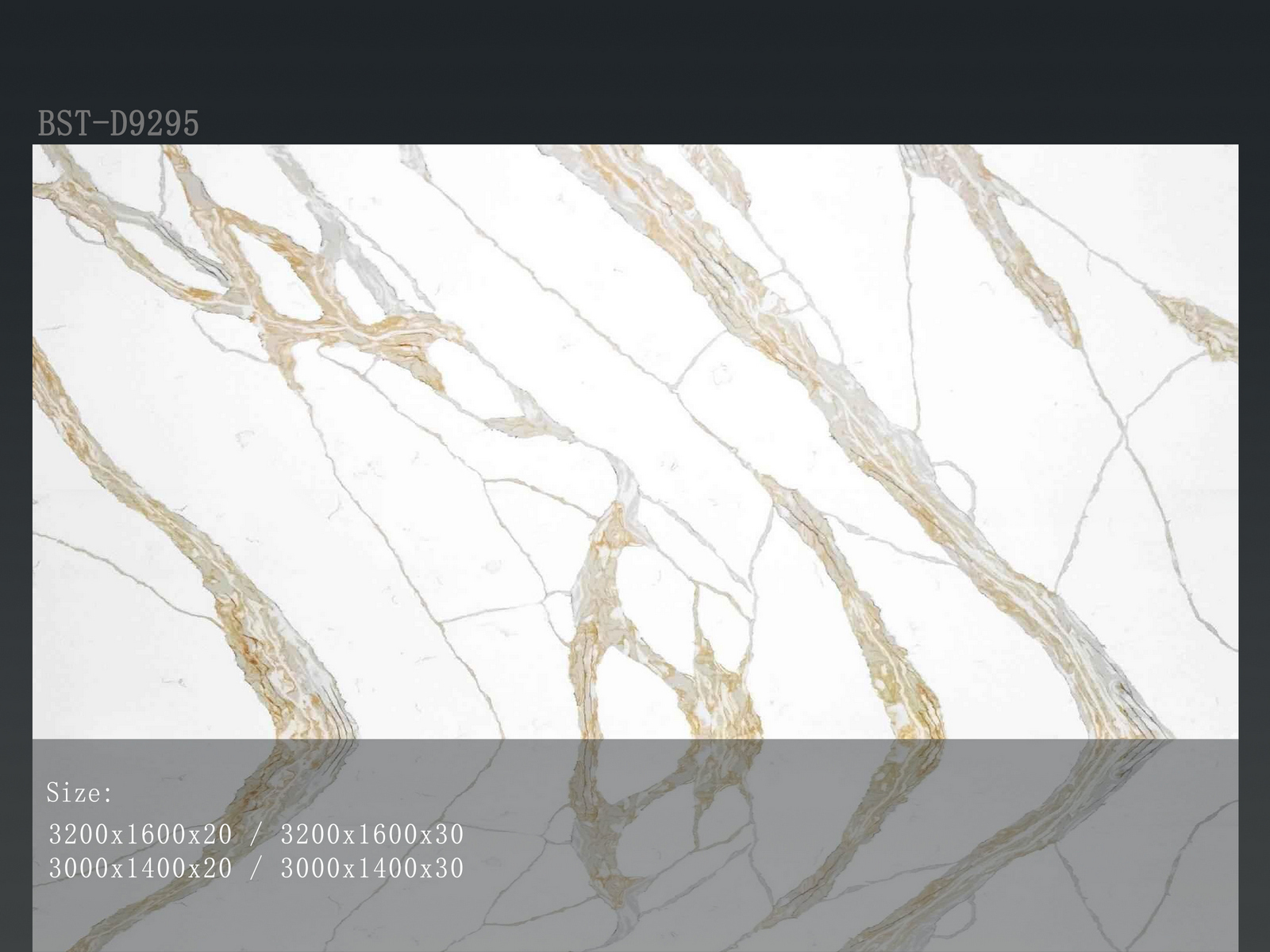
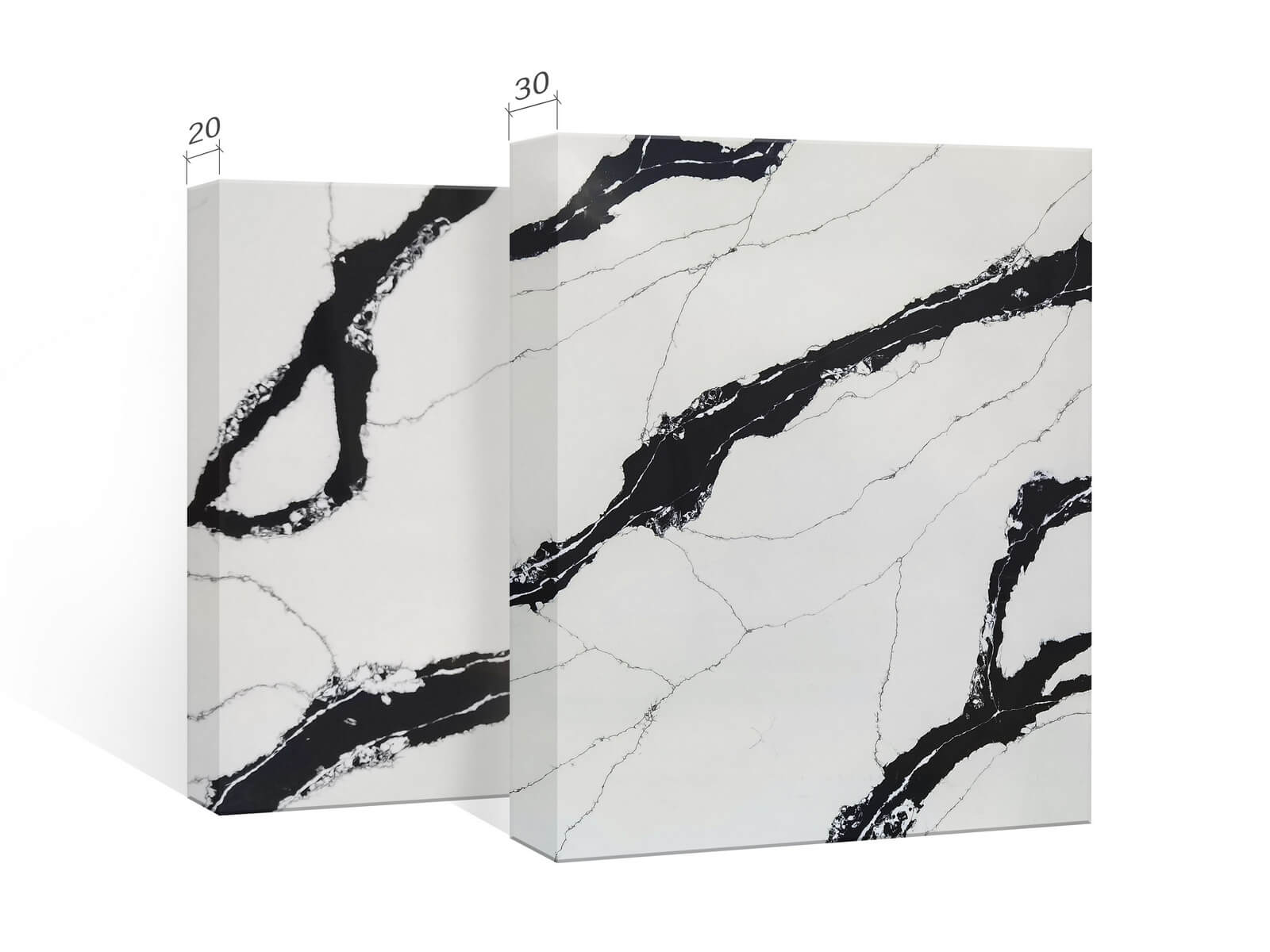
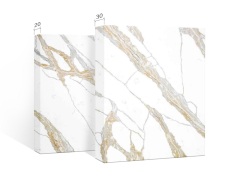
Calacatta Nile Gold quartz stone is built around one idea: a Calacatta Statuario-style surface — a bright white field, broad grey movement and warm gold running through the vein — pressed into a slab large enough that an entire island or a long run of worktops reads as one piece. It is engineered rather than quarried, and that changes what you can plan: the pattern can be laid out across a whole room instead of accepted piece by piece, and the tops arrive as a repeatable product rather than a one-off piece of stone. Fabricators and distributors specify it as an extra large calacatta quartz slab for commercial project work, and as a stock colour that can hold a showroom position — the vein is distinctive enough to sell from a board, and the sheet size suits the way a fabricator lays out a job. - Calacatta Statuario, with warmth in the vein. Calacatta Nile Gold quartz stone follows the Statuario look — a white field crossed by strong grey movement — and threads gold through the vein so the surface reads warmer than a straight grey-and-white Calacatta. - Gold that belongs to the pattern. The accent sits inside the vein as part of the design itself, so it shifts with the angle and the light rather than reading as a metallic fleck lying on top of the surface. - A focal surface on an island. On an island, a bar top or a vanity wall the vein does the work of the room's feature; keep the piece as large as the layout allows and let the pattern run uninterrupted. - Three finishes, three characters. Polished reflects light and deepens the contrast between vein and field, while matt (honed) and leather take the reflection down and let the pattern sit more quietly in soft, natural light. - Consistency across a multi-slab job. Because a large format quartz slab manufacturer controls the pattern rather than working with whatever a quarry yields, colour and vein repeat far more closely from slab to slab than natural Calacatta marble — which is what keeps a kitchen and a separate vanity looking like the same stone.
Production Process
- Raw material inspection and classification. Incoming quartz aggregate, sand and powder are checked and graded before anything is batched, so the input to a run is known before it reaches the mixer.
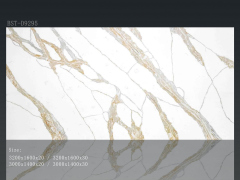
- Forming. The mixture is poured into moulds of 3050 × 1450 mm or 3250 × 1650 mm and compacted under vacuum and vibration with heat and pressure in the kiln until it cures into a solid slab.
- Grinding and polishing. Slabs go to the calibrating machine to be ground to the required thickness, then through water polishing.
- Edge cutting. A bridge cutting machine clean-cuts the edges so the slab leaves the line square and ready to pack.
- QC and packing. Every slab is inspected for surface, edges, thickness and finish before packing, so an extra large calacatta quartz slab for commercial project work leaves the line checked as a full sheet. That inspection stays in-house, so a batch that does not meet the standard does not ship. Capability | Detail Production lines | 4 automatic quartz slab production lines R&D | An in-house department developing new colours, patterns and finishes Production team | Experienced operators and an efficient management structure Quality control | A dedicated QC team; every slab inspected before it is packed Service | English-speaking sales support from first enquiry through to after-sales Track record | Quartz supplied to buyers in 109 countries
Client Feedback
American importer. Partnering with Bestone changed the shape of our business. Working with them gives us access to top-tier quartz that meets the standards our own clients expect. European wholesaler. In the construction trade the range has been a valuable addition to what we offer. Calacatta quartz slab and Calacatta white quartz countertops have consistently impressed our clients on both quality and appearance, and the reputation behind the material makes it an easy recommendation to builders and homeowners. Australian builder. Engineered quartz countertops have become a staple on our projects. The durability and elegance — quartz bathroom countertops in particular — make it a popular choice with homeowners, and the material lifts the visual appeal of a build while giving us the longevity we promise.
Large-Format Slabs & Seam Planning
- 7 m² from one sheet. The large format gives roughly 7 m² of surface — a full island top plus returns, or a long run with the offcut carried into a splashback.
- Fewer joints, placed where you want them. Every joint breaks the vein, so the point of the format is control: put the joint at a sink line, a hob cut-out or the end of a return instead of through the middle of the island.
- The size ladder. Standard and jumbo formats cover smaller work, and the super jumbo quartz slab is the format to specify when a run has to stay uninterrupted.
- Two slabs, one pattern. On runs longer than a single sheet, agree the vein direction across both slabs with your fabricator before cutting, so the movement reads continuously from one piece to the next.
- Offcuts that still earn. A sheet this size leaves usable pieces for splashbacks, upstands, shelf tops and vanity decks — cut the small parts from the same slab so the colour and vein match the main top exactly.
- Specified at project scale. Contractors and distributors order this format — an extra large calacatta quartz slab for commercial project work — when a brief spans many rooms: one format, laid out across the site, reading as a single specification.
Handling, Storage & Installation
- Unload on edge. A super jumbo quartz slab travels and lands upright on an A-frame or slab rack — never flat, and never carried on its face. Use lifting gear rated for the weight and enough hands to control the sheet.
- Store it out of the sun. Keep slabs upright in a dry, covered area away from direct sunlight; long exposure can warp a sheet and fade the colour, and grit or standing water under a slab marks the polished face.
- Respect the resin. Resin and coupling agents give the slab its working flexibility and reduce brittleness, but they also mean a thermal shock — a flame, a sudden temperature change, a hot tool — can damage the resin and the surface beneath it. Let the slab settle to room temperature before fabricating and follow the tooling guidance for engineered quartz.
- Fabricate with support. Support the sheet along its full length while cutting, keep the bed clean, and check the required distance from an opening to the slab edge with our technical team before any cut-out is made.
- Install without dragging. Carry rather than slide, support the full length as the piece goes onto the cabinets, and keep it out of direct sun on site until the room is closed.
Silica-Free Surface & Maintenance
Calacatta Nile Gold is produced as a silica-free quartz stone benchtop, which is what many buyers in Australia, the UK and North America check first before a colour goes into their range. If you need the document that supports the claim for your market, ask your sales contact and we will tell you what is available for this colour.
Day to day the surface is non-porous. Spilled wine, oil, coffee and food colouring sit on top instead of soaking in, so a damp cloth and a mild detergent handles almost everything — no annual sealing routine to schedule, no re-sealing invoice to pass on to a client, and no window in which the top is left vulnerable.
Hygiene is the quieter benefit: a non-porous face gives bacteria nowhere to settle, which is why the same material turns up in commercial kitchens and bathroom vanities as well as in homes.
A few habits keep the finish looking new. Wipe strong colour spills rather than leaving them overnight, keep abrasive pads and scouring powders off a polished face, and use a chopping board — hardness resists scratches, it does not make a knife-proof surface.
Applications
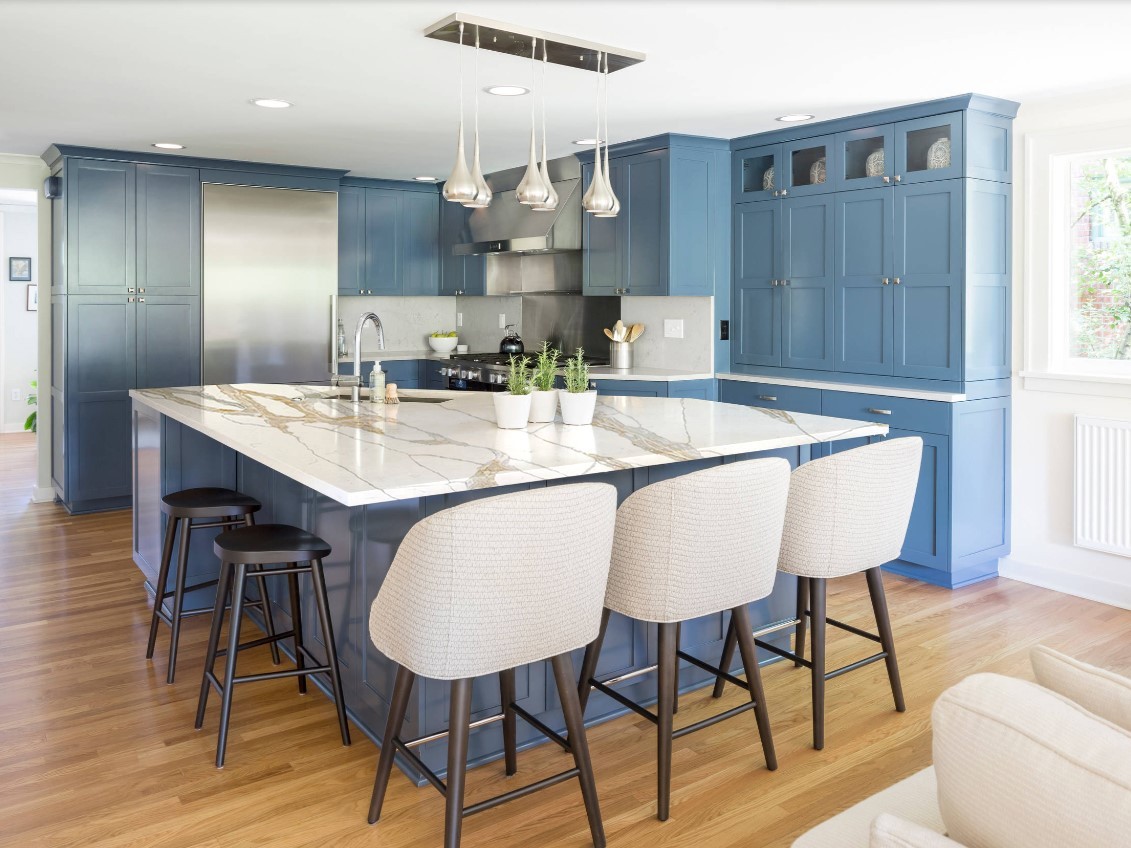
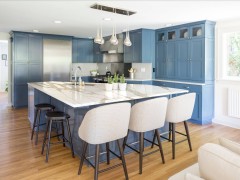
- Kitchen countertops and islands. The most common use: one piece across an island, with the sink and hob set into a surface that has no joint running through the middle.
- Bathroom vanities and vanity walls. Run the vein vertically into the splashback so the pattern carries up the wall instead of stopping at the upstand.
- Dining tables and desk tops. A top cut from a single sheet keeps an eating or meeting surface free of seams.
- Wall cladding and feature panels. Large interior panels with few joints, used where a continuous surface matters more than panel-by-panel installation.
- Interior flooring. Specified in interior schemes that call for a hard, continuous floor finish.
- Commercial fit-outs. Reception counters, bar tops, hotel bathrooms and apartment kitchens, where the same specification is repeated from room to room.
Specifications
In a working kitchen that shows up as a surface a knife, a pan base or a chair back pushed against an island edge will not easily score, and a top that takes that traffic daily keeps its polish instead of collecting a haze of fine scratches. That resilience is what puts the material into high-traffic settings — hotel kitchen pass-throughs, restaurant bars, apartment blocks of worktops — where a softer top would need re-polishing within a few years. Where the numbers matter more than the adjectives — a tender, a written specification, a client's technical reviewer — ask our sales team before the material goes into the document. For this colour you can request the measured water absorption with its test method, the flexural and compressive strength values with their methods, and the SGS report number and test date. We would rather send you a figure with the method and the date attached than a bare claim.
Colour Range & Custom Manufacturing
- More than 100 colours. The engineered quartz range runs from calacatta and carrara looks through solid whites, veined greys and sparkle surfaces — enough to build a showroom around a single supplier.
- Custom pattern development. Beyond the standard range, patterns are developed with clients for their own collections rather than only selected from a catalogue.
- Private label. As a large format quartz slab manufacturer we also produce under our clients' brands — logo printed on the back of each slab, custom labels and lot numbers available, with customer confidentiality applied.
- Several formats, one colour. Standard, jumbo and super jumbo quartz slab formats sit alongside this large slab, so a colour can be offered in more than one size.
Ordering & Delivery
- Send the specification. Colour, format, thickness, finish, quantity and destination — and tell us whether the job is a full commercial project or a first trial order.
- Check the colour first. Ask your sales contact about sample availability so the vein and the background can be judged in your own light before the order is placed.
- Price and confirmation. We quote from our own production lines, which is what keeps pricing competitive, and every order is confirmed in writing before production starts.
- Lead time. Standard lead time is 15–25 days after deposit.
- Inspection and packing. Slabs are inspected and packed before they leave; confirm the packing and shipping terms for your destination with your sales contact.
- Get in touch. Send your enquiry to info@bstquartz.com with the quantities and the destination, and our team will come back with current price and availability.
Scale & Supply Capability
Bestone has been in the stone trade since 2007 and selling through our website to overseas buyers since 2012. Production is in-house, so standard runs and custom or private-label orders are handled by one team rather than passed between suppliers. We serve distributors, fabricators, contractors and designers across North America, Europe, the Middle East, Southeast Asia and Australia, and we confirm each order in writing before production starts. Send our sales team your quantities, destination and target specification, and we will tell you exactly what we can commit to.
FAQ
What does Calacatta Nile Gold quartz stone look like in a real room?
A white field with strong grey movement and warm gold threaded through the vein, finished with a polish that picks up the light. In a kitchen it usually becomes the feature of the room, so the pattern is well-suited to a large uninterrupted surface — a full island top, or a run with no joint through the middle. Tone shifts with the light, so view a piece in your own space before the final order is placed.
Can this slab be used on a hotel or apartment project?
Yes. The large format lets a developer repeat the same surface across many rooms without a joint through the middle of each top. Colour and vein repeat closely from slab to slab, which matters when kitchens and bathrooms are fitted over several phases. Confirm the thickness and the edge detail with your fabricator for each application.
How does Nile Gold differ from the other Calacatta shades you produce?
Several Calacatta-look colours run alongside it, including Calacatta Pristine, Calacatta Statuario and Calacatta Divine. Nile Gold is the one with gold in the vein; the others read differently and are worth comparing on the same board. We can cut sample pieces of the shades you are weighing up so the decision is made side by side in your own light.
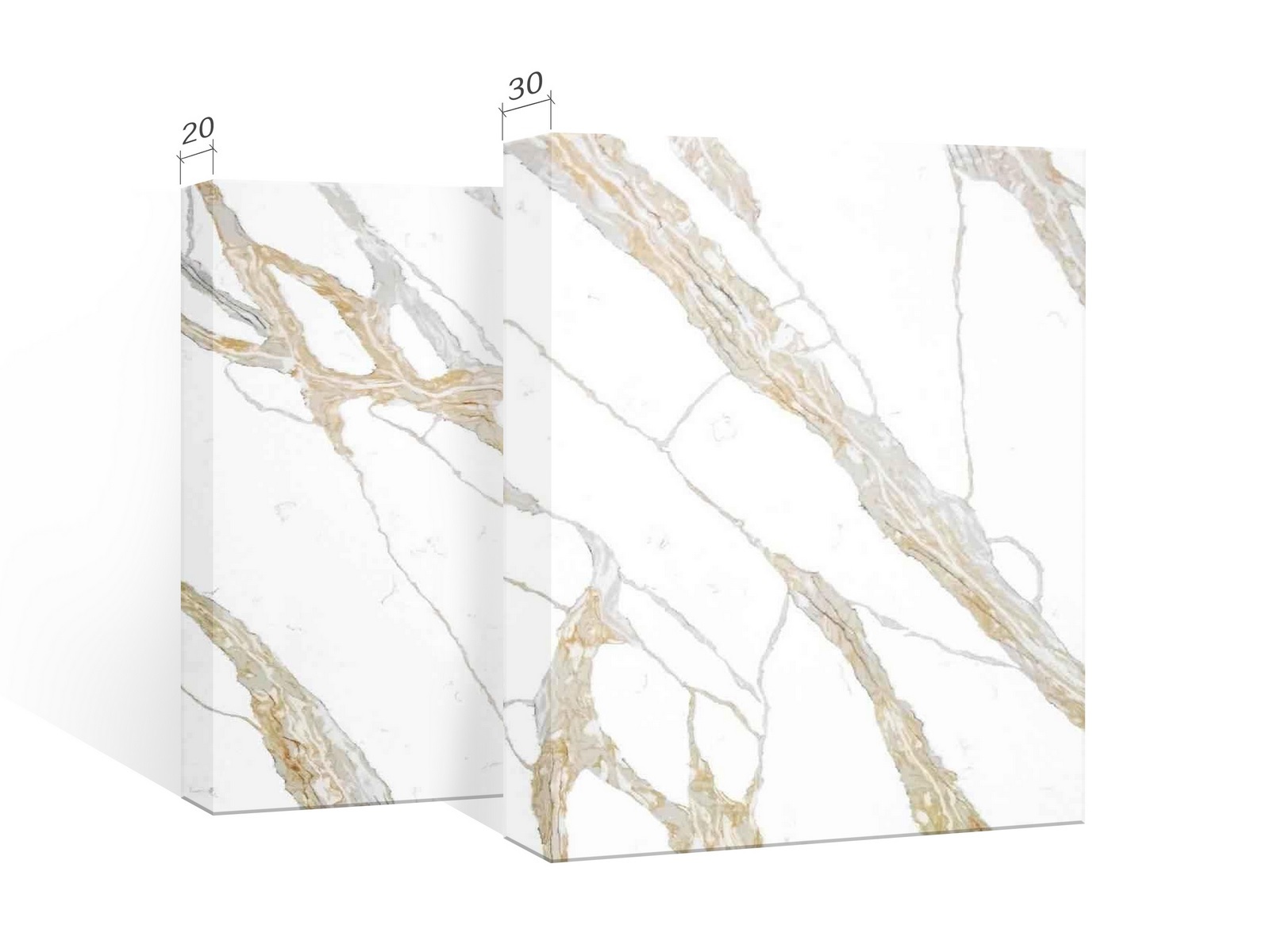
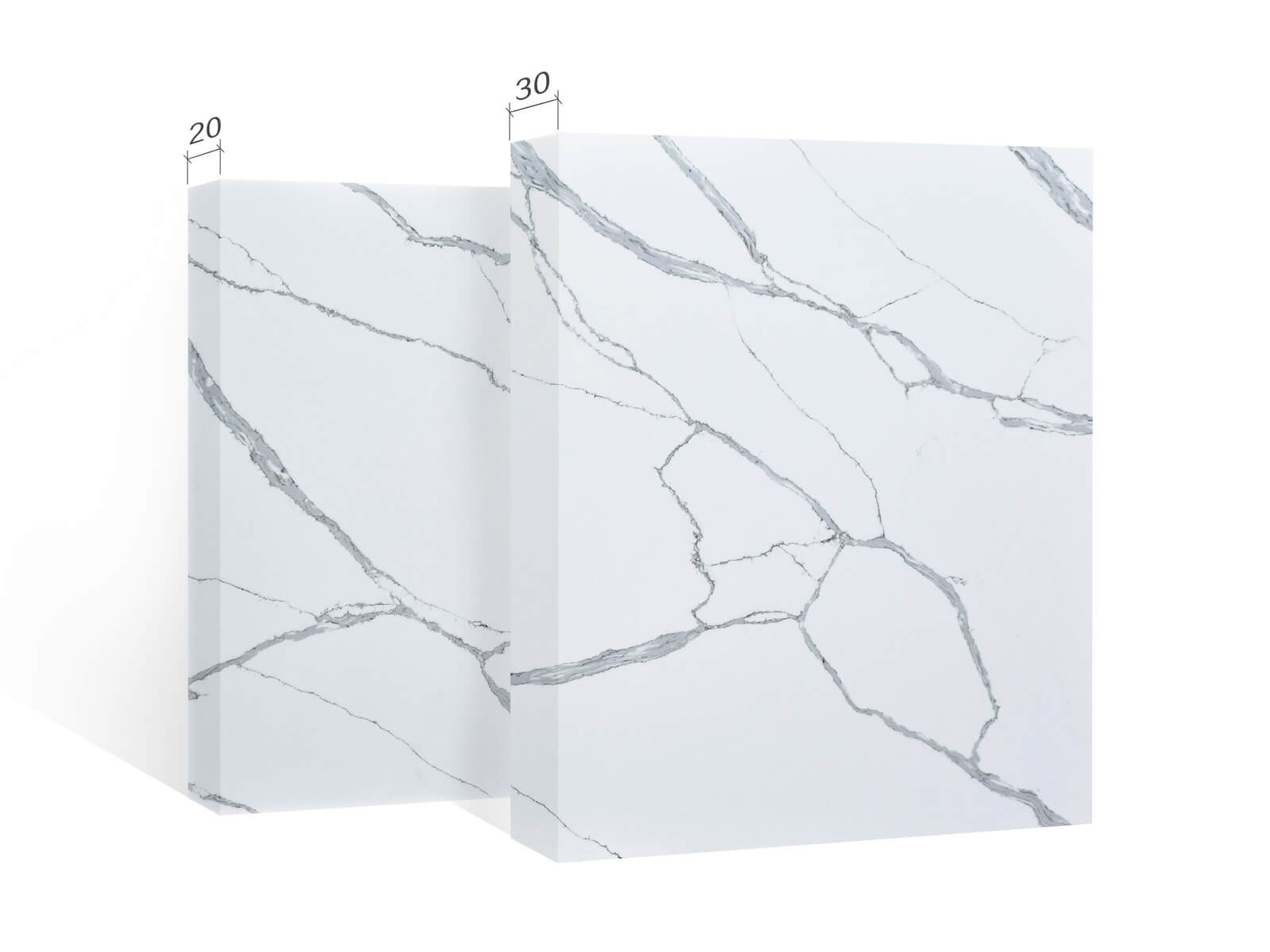
Should I specify 20 mm or 30 mm?
20 mm gives a slimmer edge profile and puts less weight on the substrate; 30 mm gives a thicker, heavier edge and is usually chosen where a substantial profile or heavy daily use is part of the design. Both thicknesses are produced in this colour and both are available in the large slab format. The edge detail your fabricator is working to is the deciding factor — the profile needs enough material behind it.
Will a super jumbo quartz slab get into the building?
That depends on the route rather than on the slab. A 2000 mm-wide sheet needs a lift, doorway or stair turn wide enough to take it on edge, and enough room on site to stand it upright once it is inside. Check the route before the delivery date and, if the full format will not make the turn, have your fabricator cut the sheet down before it goes in.